Pityriasis Rosea Treatment: Early Signs, Causes, Treatment & Recovery Timeline

If you've just noticed a large pink or tan patch on your skin followed by smaller spots spreading across your chest or back, it may be pityriasis rosea.
Pityriasis rosea is a common, harmless skin rash that usually clears up on its own within 6 to 8 weeks, though it can occasionally persist for up to 5 months.
Pityriasis rosea is not dangerous, is not linked to cancer, and is not usually contagious, although experts cannot completely rule out very rare spread through close contact.
There is no cure because it doesn't need one; your immune system handles it. Treatment can still ease the itching and improve your comfort while you wait it out. This is one of the more reassuring rashes in dermatology.

What Is Pityriasis Rosea?
Pityriasis Rosea (PR) is a temporary, self-limiting inflammatory skin rash. "Self-limiting" simply means it resolves on its own without needing medication to cure it, much like a common cold.
The name comes from Latin and Greek roots; pityriasis refers to the fine, bran-like scaling on the skin, and rosea refers to the pink-to-rose colour of the patches.
Pityriasis Rosea

It usually starts with one larger patch (called a herald patch). About 1–2 weeks later, smaller oval patches appear on the chest, back, neck, upper arms, and thighs. The face, hands, and feet are usually not affected.

Pityriasis Rosea affects roughly 0.5% to 2% of people seen in dermatology clinics at some point, most commonly between the ages of 10 and 35. It is slightly more common in women than in men. Most people will only ever get it once.
Early Signs and Symptoms of Pityriasis Rosea
The earliest sign is almost always a single patch of skin that looks different from the surrounding skin, before the rest of the rash appears.
Common early symptoms include:
- A single, oval, pink or salmon-colored patch, usually on the chest, back, abdomen, or neck
- Mild scaling around the edge of the patch, sometimes described as a fine "collarette" of skin flaking inward
- Slight itching (mild in most people, but moderate-to-severe in about 25% of cases)
- A feeling of a mild cold, sore throat, headache, or fatigue in the days before the rash appears (in some, not all, cases)
- Smaller matching patches begin to appear 1–2 weeks after the first one, spreading across the trunk
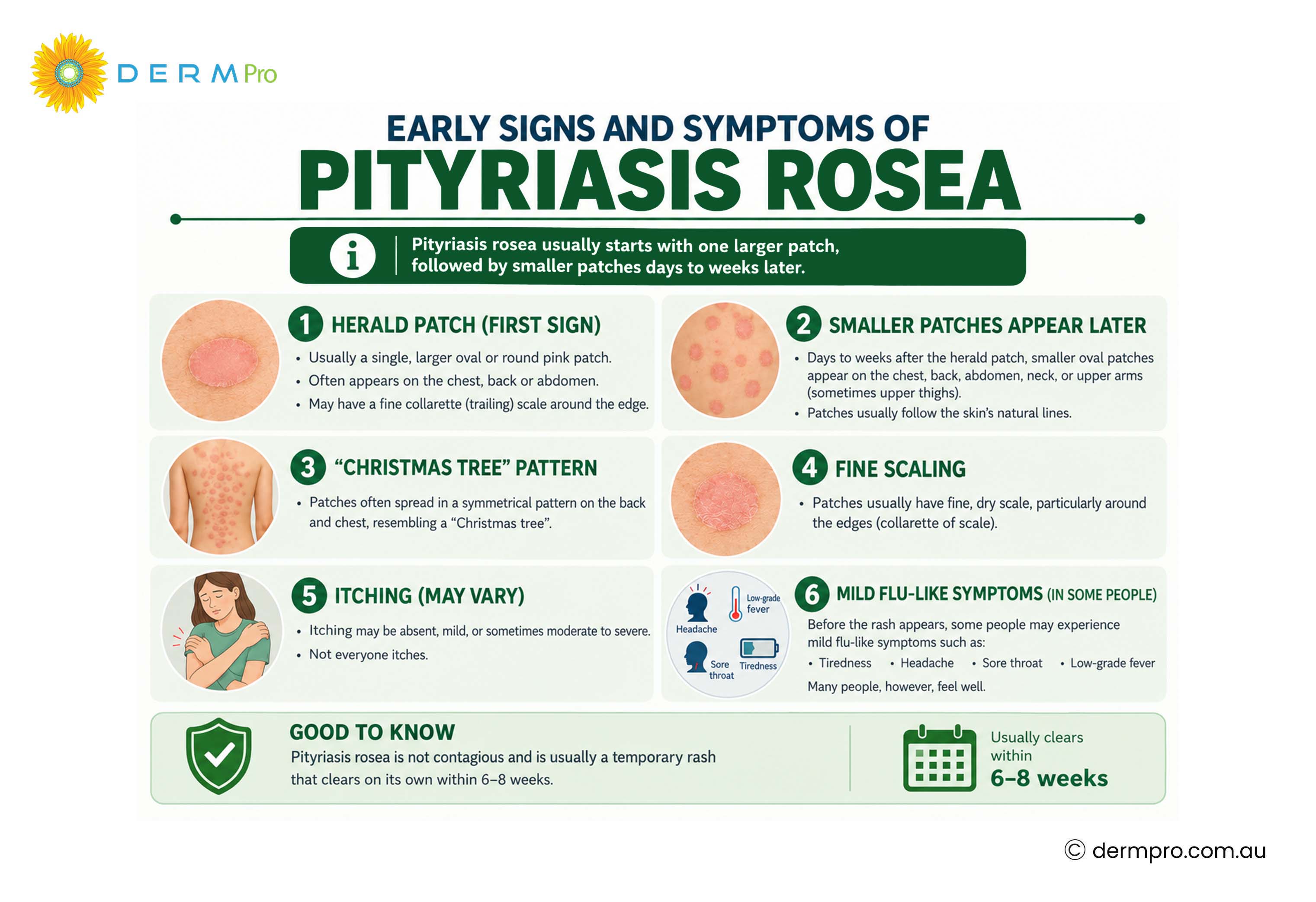
Some people never notice the herald patch at all and simply wake up one day with the widespread rash. This is normal and doesn't mean anything different is happening medically.
What Does the Herald Patch Look Like?
The herald patch is the single, larger spot that shows up first, usually 2 to 10 centimetres (about the size of a coin to a small palm), and it "announces" the rest of the rash, which is where the name comes from.

Key features of Herald Patch:
- Oval or round shape
- Pink, salmon, or light brown/tan colour (colour varies more with darker skin tones, where it can look grey, dark brown, or violet instead of pink)
- Slightly raised edges with a ring of fine scale just inside the border
- Most often found on the chest, back, abdomen, or upper thigh
- Usually, the largest lesion of the entire rash
Many people mistake the herald patch for ringworm, a coin, an insect bite, or eczema, because at this early stage, it's just one isolated spot. This is one of the most common reasons people delay seeing a doctor; they assume it's minor and unrelated to the rash that follows.
Stages of Pityriasis Rosea
Pityriasis rosea tends to move through four recognisable stages:
- Prodrome (optional): Some people feel mildly unwell, have low energy, a headache, a sore throat, or joint aches, a few days before any rash appears. This doesn't happen to everyone.
- Herald patch stage: A single patch appears, usually on the trunk. This is often mistaken for a fungal infection.
- Eruptive (spreading) stage: Over 1–2 weeks, smaller oval patches spread across the trunk, upper arms, and thighs, often following the natural lines of the skin on the back in a pattern that looks like a Christmas tree or drooping pine branches.
- Resolution stage: The patches gradually fade, flatten, and lose their scale over several weeks, sometimes leaving temporary discolouration behind.
Recovery Timeline (Week-by-Week)
One of the most important concerns regarding pityriasis rosea is: when will this go away? Here is a timeline.
|
Week |
What Usually Happens |
|
Week 1 |
Herald patch appears; often mistaken for ringworm or a bug bite |
|
Week 2 |
Smaller patches begin spreading across the chest, back, and limbs |
|
Week 3–4 |
Rash is at its most widespread and visible; itching may peak |
|
Week 5–6 |
Patches begin to flatten and fade in colour; scaling reduces |
|
Week 7–8 |
Most patches have faded significantly for the majority of people |
|
Week 9–20 |
In some people (especially with darker skin tones), flat brown or light patches may remain temporarily before the skin tone evens out |
Bottom line: Roughly 6–8 weeks is the usual recovery time, but anywhere from 2 weeks to 5 months is considered within the normal range. If your rash is still active well past 5 months, it's time to have a dermatologist take another look to confirm the diagnosis.
Causes of Pityriasis Rosea
The exact cause isn't 100% confirmed. However, there is a leading and well-supported theory.
What's strongly suspected (most likely cause): Current evidence points to reactivation of two common, low-risk herpesviruses inside the body: HHV-6 (human herpesvirus 6) and HHV-7 (human herpesvirus 7). Although they belong to the same virus family, they do not cause cold sores or genital herpes.
Most people are exposed to HHV-6 and HHV-7 in early childhood, and the virus stays dormant in the body afterwards. Researchers believe that when these viruses reactivate, often for reasons unrelated to anything the person did wrong, the immune system's response to that reactivation is what actually produces the rash, not the virus attacking the skin directly.
What is proven:
- Pityriasis rosea is an inflammatory reaction, and the immune system is clearly involved.
- Fungus, bacteria, poor hygiene, allergies, or diet do not cause it.
What remains uncertain:
- Why does reactivation happen in some people and not others?
- Whether every case of PR has the same underlying trigger, since a small number of cases may be triggered differently, including by certain medications (see below).
Drug-induced pityriasis rosea-like rashes: Certain medications, including some blood pressure drugs (ACE inhibitors), antibiotics, and a few others, can occasionally trigger a rash that resembles PR. This is worth mentioning to your doctor if you started a new medication shortly before the rash appeared.
If you are also looking for an answer to "Why did I suddenly get this rash?" the correct answer is here:
It is not caused by stress alone, poor hygiene, food, or allergies, though mild viral illness or a dip in immune function beforehand may play a role in some people.
Risk Factors
You're statistically more likely to develop pityriasis rosea if you fall into one or more of these groups, though anyone can get it:
- Age 10–35 (though it can occur at any age)
- Female sex (slightly higher rates than men)
- Recent mild viral illness or a period of lowered immunity
- Pregnancy
- Family history is not a strong factor because PR is not considered hereditary in any significant way
Who Gets It?
Pityriasis rosea can affect anyone, but it shows a clear pattern: it's most common in older children, teenagers, and young adults, and less common in young children under 4 and adults over 65. It occurs across all skin tones and ethnicities, though how it looks can vary; lighter skin tends to show pink or salmon patches, while medium and darker skin tones may show grey, violet, or dark brown patches instead.
Is Pityriasis Rosea Contagious?
No, pityriasis rosea is considered a non-contagious rash. Also, you do not need to isolate yourself, avoid your family, or worry about infecting coworkers or classmates.
Because the leading theory involves reactivation of a virus you already carry (not a new infection you catch from someone else), PR does not spread the way a cold or flu does.
Clusters of cases in the same household are rare but have occasionally been reported, which is why some researchers keep an open mind about very low-level transmission. In everyday life, this risk is low enough that most dermatologists do not recommend any special precautions.
You can generally continue to:
- Go to work or school: there's no medical reason to stay home
- Hug and have close contact with family
- Shower normally (lukewarm water is more comfortable than hot)
- Swim, once the skin isn't broken or irritated (chlorine can sometimes dry out and irritate the rash, so pat dry and moisturise afterwards)
- Exercise, though sweating, can sometimes intensify the itch temporarily
Is Pityriasis Rosea Linked to Cancer?
No, pityriasis rosea itself is not linked to cancer. It is a benign and self-resolving viral-immune reaction, not a precancerous or cancerous condition.
In rare cases, a condition called pityriasis rosea-like drug eruption or, even more rarely, a paraneoplastic rash (a skin reaction sometimes associated with an underlying illness, including certain cancers) can resemble PR closely enough to cause concern.
These look-alike cases are uncommon and usually stand out because they don't follow the typical pattern; they may last much longer, look atypical, or occur in an older adult without a normal herald patch. This is exactly why a doctor's confirmation is valuable if anything about your rash seems unusual, but it should not be a source of everyday worry for typical cases.
Can Pityriasis Rosea Appear on the Face?
Yes, but it's uncommon. Facial involvement occurs in a minority of cases, more often in children than adults. When PR does appear on the face, scalp, or hands and feet, it's sometimes called an "inverse" pattern, since it affects areas usually spared in classic PR. If your rash is heavily concentrated on the face with little elsewhere, it's worth having a dermatologist confirm the diagnosis, since other rashes (like eczema, guttate psoriasis, or a drug reaction) can look similar in that location.
Pityriasis Rosea on the Back
The back is the single most classic location for pityriasis rosea, and it's where the famous "Christmas tree pattern" is most visible. On the back, the oval patches tend to align along natural skin tension lines (Langer's lines), fanning outward and downward from the spine in a shape that resembles drooping pine branches or a Christmas tree. This pattern is one of the most reliable visual clues doctors use to diagnose PR without needing further tests.


Pityriasis on the Scalp
Scalp involvement is uncommon in classic pityriasis rosea. When it does occur, it usually appears as mild scaling or a few small patches near the hairline rather than deep within the scalp itself. Significant scalp involvement with thick scaling is more typical of seborrheic dermatitis or psoriasis, so a scalp-heavy rash is a good reason to get a professional opinion rather than assume it's PR.
Circular Skin Rash: Could It Be Pityriasis Rosea?
A circular or oval rash has several common explanations, and telling them apart matters because the treatments are completely different.
It's more likely PR if:
- One larger patch appeared first, followed by many smaller matching ones
- The scale forms a thin ring just inside the border, not raised at the edge
- The rash follows a Christmas-tree pattern on the back
- It's mildly to moderately itchy but not painful
It's more likely something else (like ringworm) if:
- There is only one or two isolated rings
- The border is distinctly raised, red, and scaly, while the centre looks clearer or more normal
- It's slowly expanding outward as a single ring over days to weeks
- You have a pet or recent skin-to-skin contact with someone who has a similar rash
If you're unsure, a doctor can settle it quickly with a simple in-office skin scraping test (see the Diagnosis section).
Pityriasis Rosea vs Ringworm
This is one of the most common points of confusion, since the herald patch of PR is often mistaken for ringworm (tinea corporis) in the first week.

|
Feature |
Pityriasis Rosea |
Ringworm (Tinea Corporis) |
|
Cause |
Suspected viral reactivation (HHV-6/7) |
Fungal infection |
|
Contagious? |
Essentially non-contagious |
Yes, spreads via skin contact |
|
Number of lesions |
One herald patch, then many smaller ones |
Usually one or a few rings |
|
Border |
Fine scale just inside the edge |
Raised, red, distinctly scaly outer ring |
|
Centre of the patch |
Similar colour throughout, may fade centrally |
Often clearer/lighter than the border |
|
Pattern |
Christmas-tree pattern on the back |
No specific pattern; can appear anywhere |
|
Growth speed |
Multiple patches appear over 1–2 weeks |
Single ring slowly expands over days–weeks |
|
Diagnosis test |
Usually, a clinical exam alone |
KOH skin scraping shows fungal elements |
|
Treatment |
Supportive care (antihistamines, moisturiser) |
Topical or oral antifungal medication |
|
Duration |
6–8 weeks (self-resolving) |
Continues until treated; won't resolve alone |
Diagnosis
In most cases, a dermatologist or general practitioner can diagnose pityriasis rosea just by looking at it and asking about the timeline of your rash; no lab tests are required.
They'll typically check for:
- The presence (or history) of a herald patch
- The Christmas-tree distribution pattern on the trunk and back
- The characteristic fine, inward-facing scale (collarette scale)
- Sparing of the face, palms, and soles in classic cases
When additional testing is used:
- KOH skin scraping: to rule out ringworm/fungal infection, especially if there are only one or two patches
- Blood tests: occasionally used to rule out secondary syphilis, which can mimic PR (this is a standard, routine precaution, not a cause for alarm)
- Skin biopsy: rarely needed, reserved for atypical or long-lasting cases
Pityriasis Rosea Treatment
Because pityriasis rosea resolves on its own, the goal of treatment is comfort, not cure. There is currently no medication proven to make the rash disappear faster in the majority of typical cases, but several options can meaningfully reduce itching and irritation while your body clears it naturally.
|
Option |
What It Does |
Best For |
|
Oral antihistamines |
Reduce itching, especially at night |
Mild-to-moderate itch, sleep disruption |
|
Topical corticosteroid creams |
Calm inflammation and itching in specific areas |
Localised itchy patches |
|
Moisturizers/emollients |
Soothe dry, irritated skin and support the skin barrier |
Everyone, as daily supportive care |
|
Oral corticosteroids |
Stronger anti-inflammatory effect for severe, widespread itching |
Severe, disruptive symptoms only, short-term, doctor-supervised |
|
UVB phototherapy |
Controlled light therapy that can shorten symptom duration in some studies |
Widespread, persistent, or severe cases, done under medical supervision |
|
Antiviral therapy (e.g., acyclovir) |
May shorten the course in some studies, particularly in early or severe presentations |
Considered case-by-case by a doctor; not routine for typical mild cases |
|
Lukewarm oatmeal baths |
Soothes itching and calms skin naturally |
Mild home relief |
Treatment Options Compared
Important nuance: Evidence for antiviral therapy and phototherapy shortening the overall course is mixed and not strong enough for either to be considered a routine, first-line treatment for everyone. They're reserved for more severe or unusually persistent presentations and should be a decision made with a dermatologist, not a self-directed choice.
Home Remedies That May Relieve Symptoms
These won't cure PR, but they can noticeably ease the itching and discomfort while you wait for the rash to run its course.
- Lukewarm (not hot) showers or baths: hot water intensifies itching
- Colloidal oatmeal baths: soothe and calm irritated skin
- Fragrance-free moisturiser, applied right after bathing while skin is still damp
- Loose, breathable cotton clothing reduces friction and sweat-related irritation
- Cool compresses on especially itchy areas
- Avoiding scratching: scratching can break the skin, increase irritation, and slightly raise the risk of temporary discolouration or, rarely, secondary infection
- Mild, fragrance-free laundry detergent while the rash is active
Steroids for Pityriasis Rosea
Topical corticosteroid creams (like low- to mid-potency hydrocortisone-family creams) are commonly recommended by doctors to calm itching in specific patches. They're safe for short-term use when directed by a healthcare provider and are one of the most reliably helpful treatments available for symptom relief.
Oral corticosteroids (steroid pills) are used far less often and are generally reserved for severe, widespread, intensely itchy cases that significantly affect sleep or daily life. They are not first-line and come with more potential side effects, so they're used at a doctor's discretion, typically for a short course.
A steroid, whether topical or oral, treats the symptoms, the itch and inflammation, not the underlying cause, and it will not make the rash disappear faster in most people.
Things to Avoid During Recovery
To avoid making the rash more irritated or prolonging your discomfort, try to steer clear of:
- Hot showers or baths: heat worsens itching
- Harsh soaps, scented body washes, or scrubbing the rash
- Tight, synthetic, or non-breathable clothing
- Excessive sun exposure: UV light can sometimes darken the patches or the marks left behind afterwards, so use sunscreen on exposed rash areas if you'll be outside for a while
- Scratching, even though it's tempting, increases the chance of leftover discolouration
- Self-diagnosing and using antifungal cream without confirming it isn't ringworm, since antifungals do nothing for PR and can further irritate the skin
- Unregulated "detox" remedies or harsh essential oils, which can irritate already-sensitive skin
Pityriasis Rosea During Pregnancy
Most cases of pityriasis rosea in pregnancy are mild and resolve without complications, just like in anyone else. However, some studies, most notably research led by Italian dermatologist Dr Cosimo Drago, have suggested that when PR develops during the first 15 weeks of pregnancy, there may be a modestly increased risk of complications such as preterm birth or, in some cases, pregnancy loss, though the overall research base remains limited compared to more common pregnancy conditions.
What this means practically: if you are pregnant and develop a rash that looks like pityriasis rosea, it's genuinely worth having your obstetrician or a dermatologist confirm the diagnosis and monitor you appropriately, rather than assuming it's harmless and waiting it out alone. This is one of the clearest cases in this article where prompt medical evaluation is the right call rather than optional.
When to See a Doctor?
|
See a Doctor If.. |
Because... |
|
You're not sure if it's ringworm, eczema, or something else |
A quick exam or skin scraping can confirm the diagnosis in minutes |
|
The rash lasts longer than 3 months without improving |
Atypical or prolonged PR should be re-evaluated |
|
You're pregnant, especially in the first trimester |
Warrants monitoring given research on pregnancy outcomes |
|
The itching is severe and disrupting sleep or daily life |
Stronger prescription treatment may help |
|
You develop fever, significant fatigue, or feel generally unwell |
Should be evaluated to rule out other causes |
|
The rash appears on your face, palms, or soles predominantly |
Less typical for PR and worth confirming |
|
You started a new medication shortly before the rash appeared |
Could be a drug-induced rash rather than true PR |
|
The skin becomes painful, oozing, or shows signs of infection |
Possible secondary infection from scratching needs treatment |
If none of these apply and your rash matches the classic pattern described above, it's reasonable to manage it at home with supportive care and simply monitor it, but a first-time diagnosis confirmation from a doctor is always a safe, sensible step.
What to Expect?
It is a benign, self-limiting condition that resolves completely in the vast majority of people, typically within 6 to 8 weeks, without leaving permanent scarring.
Some people, particularly those with darker skin tones, may notice temporary discoloration: either lighter (hypopigmentation) or darker (hyperpigmentation) patches, where the rash used to be. This is not scarring, and it fades gradually over weeks to months as the skin's natural pigment evens back out.
Recurrence is uncommon, affecting roughly 2% of people who've had it before, so most people only experience pityriasis rosea once in their lifetime.
Frequently Asked Questions
Will it spread across my whole body?
It commonly spreads across the trunk, upper arms, and thighs, but it typically spares the face, palms, and soles in classic cases.
Is it fungal?
No. Despite looking similar to ringworm at first, pityriasis rosea is not a fungal infection and doesn't respond to antifungal treatment.
Can I shower normally?
Yes, you can take a normal shower. However, lukewarm water is best. But hot water tends to worsen itching.
Can I go to work or school?
Yes. It's considered essentially non-contagious, so there's no medical need to stay home.
Can I swim?
Yes, though chlorinated water can dry out the rash, so moisturise afterwards.
Can I go out in the sun?
Brief, sensible sun exposure is fine, but protect the rash with sunscreen or clothing to avoid worsening any discoloration.
Can I scratch it?
No, you should not scratch it. Because scratching can prolong irritation and increase the chance of leftover discolouration or, rarely, skin infection.
Will it leave scars?
No permanent scarring is expected. Temporary light or dark marks can occur but fade over time.
Can it come back?
It's uncommon, but around 2% of people experience it a second time.
Is it dangerous during pregnancy?
Usually mild, but PR occurring early in pregnancy (first 15 weeks) has been linked in some research to a higher risk of complications, so prompt evaluation is recommended.
Is it linked to cancer?
No, typical pityriasis rosea is not linked to cancer. Rare look-alike rashes exist, which is why an accurate diagnosis matters.
What makes it worse?
Heat, hot showers, sweating, tight clothing, harsh soaps, and scratching can all intensify itching and irritation.
How long before it disappears completely?
Most cases resolve within 6–8 weeks; some take up to 5 months. Anything longer warrants a follow-up visit.
This blog is written only to inform and reassure and does not replace a professional medical evaluation. If you're unsure whether your rash is pityriasis rosea, if it's causing significant discomfort, or if you're pregnant, please consult a licensed dermatologist or your healthcare provider for an accurate diagnosis and personalised care plan.
References:
DermNet New Zealand. Pityriasis Rosea. https://dermnetnz.org/topics/pityriasis-rosea
Katta R, Schlichte M. Pityriasis Rosea. StatPearls Publishing; 2024. https://www.ncbi.nlm.nih.gov/books/NBK448091/
American Academy of Dermatology Association. Pityriasis Rosea. https://www.aad.org/public/diseases/a-z/pityriasis-rosea-overview
Drago F, Ciccarese G, Rebora A, et al. Pityriasis Rosea During Pregnancy: Major and Minor Alarming Signs. Dermatology. 2018;234(1–2):31–36.
Was this article helpful?
Your feedback helps us create better content for everyone.