Got Skin Health Questions
Find Your Answer Here
Find your skin type
What skin type do I have?
Several factors can impact your risk of developing skin cancer, one of them being your skin type. DermPro helps you identify your skin type to learn the most effective ways to protect yourself from skin cancer and receive personalised advice, assessment and care.
Based on your Skin Type and Risk Profile, in case of Risk or High Risk Assessment, DermPro will provide you with a personalised skin health journey, guiding you and staying with you through the process before and after your visit to the doctor.
How to do that?
Open the DermPro app and fill in the questionnaire to find out your skin type and risk profile.
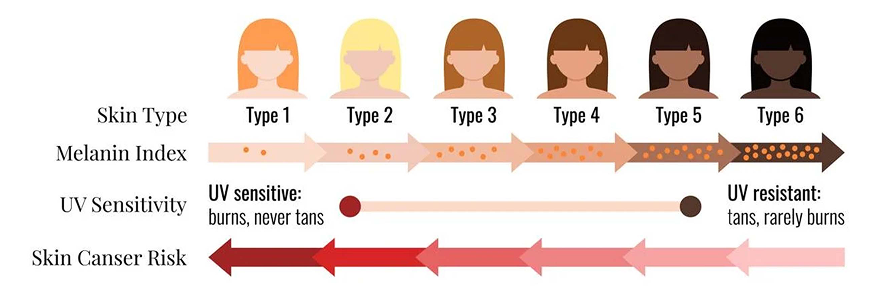
* The Fitzpatrick scale is used by dermatologists as a numerical classification for human skin colour and how it responds to the sun.
Are Skin Spots and Moles the Same?
No, they are not. Moles come in different types and each one looks a little different. Most are completely harmless, but some do need a closer look from a doctor.
Common Moles
These are round, evenly in colour, and smaller than a pencil eraser. They are the most typical type of mole and most adults have anywhere between 10 and 40 of them on their bodies.
Atypical Moles
These moles have an irregular shape or uneven colour. They are not always dangerous, but it is a good idea to keep an eye on them and get them checked if anything changes.
Congenital Moles
These are moles you are born with. Smaller ones are usually nothing to worry about, but larger congenital moles carry a slightly higher risk and should be reviewed by a dermatologist.
Junctional Nevi
These are flat, dark brown moles that form at the border between the top two layers of skin. They are generally harmless but should be monitored over time.
Intradermal Nevi
These appear as raised, flesh-coloured or light brown bumps on the skin. They are very common and almost always benign, meaning they pose no health risk.
Halo Nevi
These are moles surrounded by a white ring, which appears when the skin around the mole loses its pigment. They are mostly harmless but worth mentioning to a doctor if you notice one.
Compound Nevi
These moles are a mix of flat and raised. They are usually safe, but it is worth keeping track of any changes in their size, shape, or colour.
Spots to Keep an Eye On
Not every spot is a mole. Here are three types worth knowing:
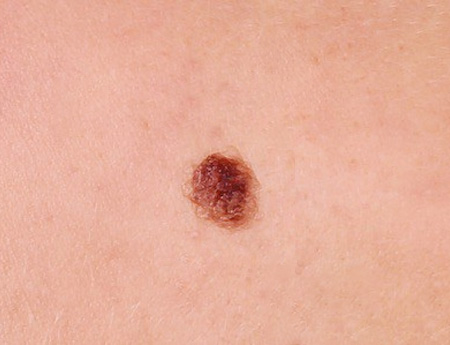
Moles
Usually brown or black, round or oval. Most are fine. Track any that change shape, colour, or size.
Most Common Concern
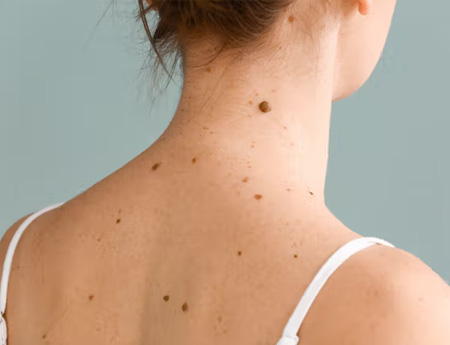
Red Spots
It could be cherry angiomas, rosacea, or irritation. Often harmless, but persistent red spots should be checked.
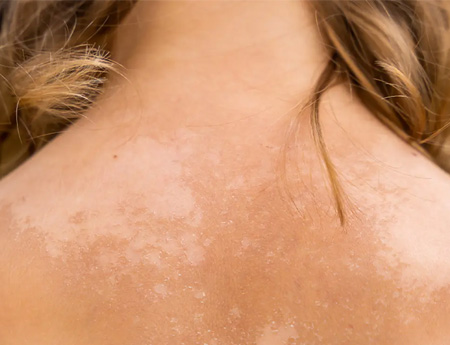
White Spots
Can appear from sun damage, fungal infections, or vitiligo. Most aren't dangerous but deserve attention if spreading.
What Does Skin Cancer Look Like?
Use the ABCDE rule to check any mole or spot for warning signs. Asymmetry means the two halves of the moles do not match. Check the border to see if the edges look ragged, notched, or blurry. Colour is another clue, as a single spot showing multiple shades of brown, black, red, or white needs attention. Diameter matters too, and anything larger than 6mm, about the size of a pencil eraser, is worth noting. Finally, watch for anything evolving, which means any change in size, shape, colour, or feel over time. If a mole or spot checks even one of these boxes, see a dermatologist. Skin cancer is highly treatable when caught early.